
For the last 21 years I have been privy to the tone-und-style diktats of some the largest brands in the known universe.

These brand guidelines or style guidelines or brand documents, as they have been variously and unimaginatively called, were written by some of the most august, venerable touts of branding in the world - great names writing about great names hoping to make a still greater name for themselves.

There was a common denominator in almost all of these documents.
They specified that the brand voice must be Approachable.

Approachable!

Which moron wrote that?
Has there been a commercial venture since the beginning of time that wanted to be unapproachable?

Approachability has been the core of every act of commerce, from the oldest profession in the world to the youngest. Approachability is about what makes you friendly (don't get me started on that word!) and accessible.
Anyone who is selling anything wants to be friendly and accessible.
Butchers. Bakers. Candlestick makers.
Whores. Priests. Doctors. Clairvoyants. Snake oil salesmen. Arms dealers. Pushers.
They all want you to be able to find them, and, having found them, to like the experience of dealing with them enough to want to come back for more.
(There are exceptions and we will come to those another time.)

Approachable!
A pedestrian crossing is approachable.
A pedestrian crossing is also, well, pedestrian.


copyright 2006 Gavin Barrett All rights reserved
A recent Marketing Magazine issue interviewed research maven Kaan Yigit on how the increase in our multicultural population will affect banks and their marketing.

“The growth of major ethnic cultural groups has been quite rapid in the past 10 years and it will continue for the next 10,” said Kaan, director of Solutions Research Group’s new Diversity in Canada study. “Every 10 years, you’re looking at 2.5 million new immigrants. That’s a lot of people with no brand preference–they don’t know one bank from the next."

Think about it. 2.5 million people.
A population the size of Toronto, every ten years. A population that will need to borrow to finance a new life.

That's a whole lot of new homes, new cars, new kids in school.
That's a whole lot of money in the pipeline.
Mortgages. Car loans. RESPs. Student loans.

The immigrant class Canada attracts is well-educated, professional, equipped with a strong work ethic and a fairly sophisticated world view. For immigrants, bad debts have a cultural stigma associated with them. In other words, to a bank, immigration provides a tide of well-behaved, low-risk customers.

So are Canada's banks making their presence felt among new Canadians?
Actually, the silence is deafening.

Name one bank RESP campaign that is based on the insight that South Asians and Chinese place a very high value on education. Or name an ad that leverages the cultural tendency to save and invest.

One thing banks seem to execute effectively enough is what I call the "insert-visible-minority-here" (IVMH to friends) strategy. It's better than nothing I suppose. IVMH is itself a relatively new phenomenon, accounting for the sudden appearance (c. 2002) of multiple ethnicities in bank advertising. Advertising that until then, had been - how to say this delicately? - colourless.

And now? Surely they've learned?
Oh no. Banks continue to offer the same insipid generic products.
Bank multicultural communications seem to be limited to meaningless sponsorships at random cultural events.
And the absence of cultural insight in bank advertising means that when anything is said, it is sans resonance, sans relevance, and alas, absolutely sans colour.

“Whoever reaches a little bit more deeply, with a little bit more enthusiasm, and perhaps makes sense of (immigrants’) life stages or cultural context, is going to have a bit of an edge.” said Mr Yigit to Marketing Magazine.

I said something very similar to Strategy Magazine when it came out with a multicultural issue - a full five years ago.
I guess the banks just can't understand our accents Mr Yigit.


copyright 2006 Gavin Barrett All rights reserved
Received some feedback that my posting titled "Where do we come from" required some clarification.

It's all very well having multiculturalism in your DNA when you were born into a fragmented 300 language market.
But how does it actually work?
How do you advertise to multicultural audiences in a predominantly anglophone or francophone society?

You asked.

When we work on a multicultural campaign, we start with anthropological, observation-based research.
We identify the habits and patterns our target audiences have formed since arriving in Canada.
We isolate their motivators and stumbling blocks. We observe them closely, as they live, where they live – at home, in malls, in chat rooms, at events. How closely do we watch them? If they sneeze, we’re there to say gesundheit.

In short, we look hard at our consumers. We listen hard to what they say.
We think hard about what will motivate them most.
And we work hard to produce the best advertising.

It’s easy really.


copyright 2006 Gavin Barrett All rights reserved
What on earth is a Bheja Bazaar?

Bheja is the Hindi word for brains.
Bazaar is the Hindi word for market.

So, Bheja Bazaar, my multicultural amigos, is a market for brains.
Or to look at it another way, it's brains, for market.

Grey sells.


copyright 2006 Gavin Barrett All rights reserved

Just recently, I was confronted with two questions
"Where do you come from?"
And "Where are you headquartered?"

Barrett and Welsh is headquartered in Toronto, Canada.
We have roving branch offices in dim sum restaurants, bubble tea parlours, kabab houses, dosa palaces, Turkish cafes and roti huts.
We have affiliates in Vancouver, Washington D.C., New York, Mumbai (India), Hong Kong and Dubai.
We have ideas in bathtubs, backyards, bedrooms and cars.
(Not to mention elevators and lifts, apartments and flats.)

We were established as a full-service agency in 2004.
Before that we operated as a creative consultancy, serving some of Canada’s largest agencies.
Our Mom was a Mughal queen. Our Dad was Genghis Khan.

And where do we come from?
Bombay. Hong Kong. Delhi. Singapore. London. Toronto. Calabria. Berlin. Beijing. Palermo. Next door. Faraway. Neverneverland. Narnia. Bollywood.

Or to look at our origins another way. we were appalled by the poor quality of advertising Canada's ethnic markets are faced with - produced mostly by ‘translator agencies’. We wanted to change all that.

And that, dearly beloved, is where we come from.


copyright 2006 Gavin Barrett All rights reserved

There has been some discussion in marketing circles about Chinese consumers being closer to their own heritage and culture than South Asians. It's not a defensible argument.

Is Alice, a Mandarin-speaking dollar-store-owning-mum, closer to her own mainland Chinese culture?
Or is Gurpreet - an English-speaking Punjabi-sweets-and-samosa-takeout-owning-mum closer to her roots in Punjab?

Who feels more connected to her homeland or her ethnic origins?

Let's look at Alice, married, with two kids; she celebrates the Chinese New Year, speaks Mandarin at home, reads the Mandarin newspaper, watches Mandarin TV and sends her kids to extra Chinese language classes and ballet, but is Catholic (the largest single religious denomination among Chinese immigrants in the Greater Toronto Area) and hopes her children will find Chinese mates for themselves when they grow up.

And Gurpreet? Also married, with two kids, she celebrates Baisakhi, shares her home with at least one set of in-laws, speaks a combination of Punjabi and English at home, reads the Toronto Star, occasionally picks up a free Indian newspaper, usually in English, watches Omni and English TV, goes to the gurdwara religiously (and takes her kids with her), attends several picnics and Punjabi reunions with her family and is already thinking of what will be the best possible way to arrange a marriage for her kids.

To sum up: It's true that the Chinese simply cannot access mainstream Canadian culture with the same ease that South Asians do. However this does not automatically make the Chinese closer to their own culture than South Asians are to theirs.
It's only true that the Chinese are more isolated from the mainstream by the barrier of language.

Successful marketing to these audiences is a matter of cultural insight, not of language.
(It's the same approach that works in the mainstream after all).
If we connect with them in their own language, sure, they'll hear us.
But if we connect with them on their own wavelength, they'll actually listen to us.

Language may help you get your foot in the door.
Understanding, on the other hand, will get you invited to dinner.
And that, my friends, is where the gravy is.


copyright 2005 Gavin Barrett All rights reserved.


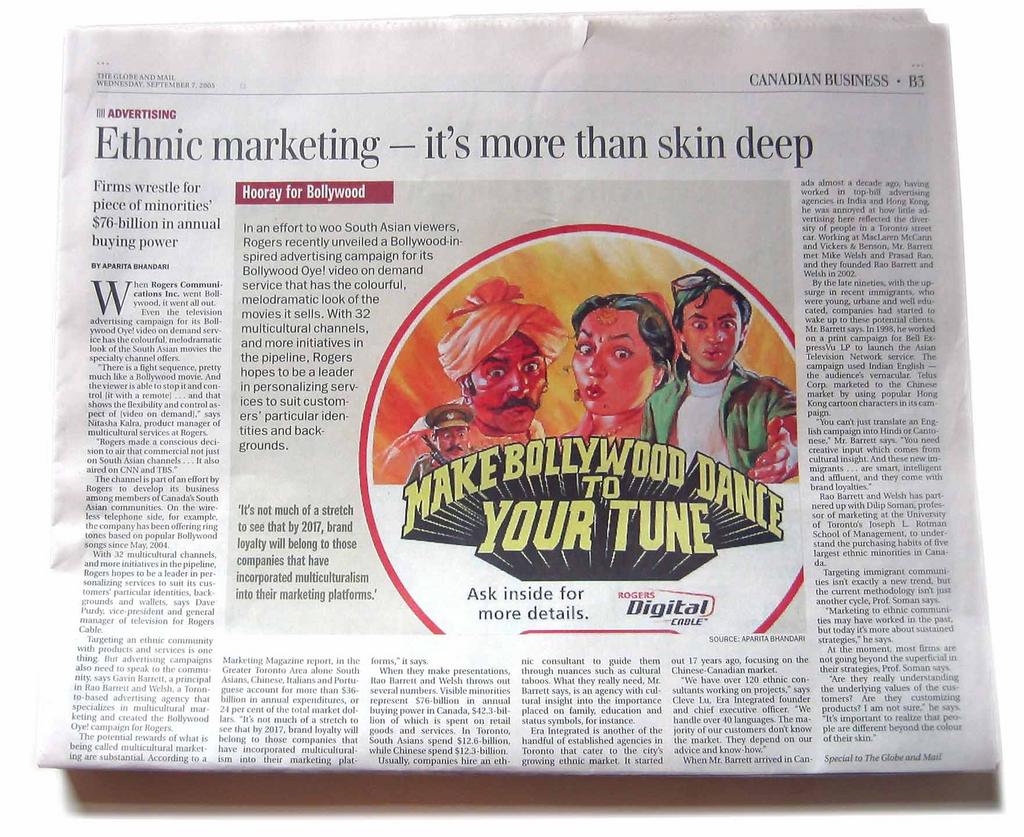
For our award-winning Rogers Bollywood Oye! campaign, there certainly seems to be life after advertising. The Globe and Mail, Canada’s national newspaper featured our work front and centre in this prominent, insightful article on multicultural marketing by Aparita Bhandari. Our strategic and creative leadership was amply on display. And our clients were quoted, yet again. It appears this is a campaign destined for recognition — it has just picked up a couple of gold awards at Promax and C-TAM — shows that celebrate the world’s best marketing work in the cable, television and entertainment businesses. Want to know what the article said? Email Gavin at gavin@barrettandwelsh.com and he’ll send you the text.

Popular Posts

@ Gavin Barrett. Powered by Blogger.

Plagiarism Watch!